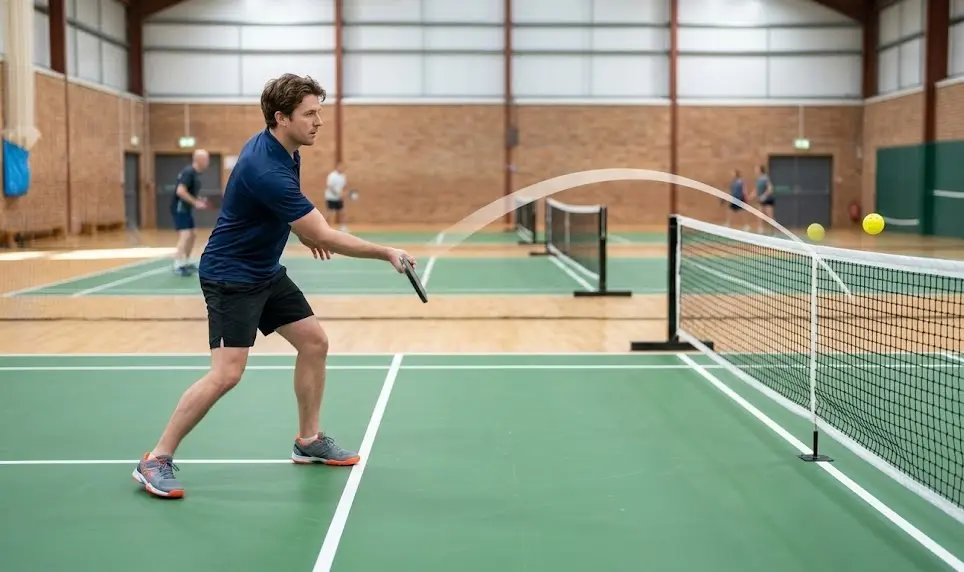
If you've played pickleball a few times, you've probably noticed something. Some players seem to always end up at the kitchen line controlling the point, while others stay stuck at the back of the court watching their opponents dominate. The difference is usually the third shot drop.
It's not the flashiest shot in pickleball. But ask any improving player what changed their game and the third shot drop comes up almost every time.
Why is it Called the Third Shot?
In doubles pickleball, the first three shots of every rally follow a predictable sequence:
- Shot 1 — the serve, hit from the baseline
- Shot 2 — the return of serve, hit by the receiving team
- Shot 3 — the serving team's first reply after the return bounces
The serving team is at a structural disadvantage after the serve. The receiving team can advance to the kitchen line immediately after returning, while the serving team must wait for the ball to bounce before moving forward. That means after two shots, the receiving team is at the net and the serving team is still at the baseline.
The third shot is the serving team's first real opportunity to do something about that imbalance.
What is the Third Shot Drop?
The third shot drop is a soft, arcing shot hit from the baseline that lands in the kitchen — the non-volley zone on the opponent's side of the net.
The goal is not to win the point outright. The goal is neutralisation. You're taking pace off the rally and buying time to advance from the baseline toward the kitchen line.
A well-executed third shot drop lands low and soft in the kitchen, forcing your opponents to hit upward from below the net height. A ball hit upward gives them no power to attack with. That brief window — while the ball is in the air and they're waiting for it to bounce — is when you move forward.
Think of it as a reset. You're not trying to win the rally on shot three. You're trying to survive it and get into position.
Why You Can't Just Hit Hard
The instinct for most beginners — especially those coming from tennis — is to hit the third shot with pace. Drive it hard at the opponents, put them under pressure.
The problem is that your opponents are standing at the kitchen line. A hard, flat ball aimed at two players standing at the net is exactly what they want. They can volley it straight back at your feet before you've taken a step forward. You've given them pace to work with and they'll use it against you.
The drop works because it takes that pace away. A soft ball that must bounce low in the kitchen gives opponents nothing to attack. They have to let it bounce, hit it gently upward, and the rally resets on more neutral terms.
What Makes a Good Third Shot Drop
It lands in the kitchen — specifically in the front half of the kitchen, close to the net. A drop that lands deep in the kitchen gives opponents more time to read it and attack. You want the ball dying near the net.
It clears the net with some margin — a ball clipping the net tape and dropping short is just as bad as one that goes long. Aim for a gentle arc that peaks a foot or two above the net before dropping.
It's soft enough to force an upward reply — if your drop sits up and your opponents can take it out of the air or drive it back aggressively, it wasn't low enough. The ball needs to force them to hit up.
It's hit after the bounce — the two-bounce rule means you must let the return of serve bounce before playing shot three. You have a moment to set your feet and make a controlled shot rather than reacting on the run.
The Most Common Mistake
Hitting it too hard.
Most beginners use the same power on the third shot that they use for groundstrokes. The court is short — 13.4 metres from baseline to baseline — and a powerful shot from the baseline will sail long or sit up invitingly for your opponents to attack.
The third shot drop requires a compact, controlled swing. The softness comes from the angle and arc of the shot, not from slowing your swing to a crawl. Think touch and placement rather than pace and power.
When to Use It — and When Not To
The third shot drop is the standard choice when:
- Your opponents are both at the kitchen line
- The return of serve was deep, giving you time to set up
- You want to transition from the baseline to the net
Sometimes a third shot drive — a harder, flatter shot — makes more sense:
- When the return of serve is short, giving you an easy ball to attack
- When one opponent hasn't reached the kitchen line yet
- When you want to mix up the pattern and keep opponents guessing
The drop vs drive decision is one of the most discussed topics in club pickleball — knowing when to use each is a significant step forward in your game.
Most club players at Nottinghamshire sessions default to drives early on. Learning when to drop instead is one of the clearest signs of improvement.
How to Practise It
The third shot drop is one of the best shots to practise alone or with just one partner — you don't need a full four-player game.
Solo wall practice: Stand at the baseline and hit soft, arcing shots at a target marked on a wall at net height. Focus on the arc and the landing spot rather than pace.
Two-player baseline drill: One player feeds from the kitchen line, the other practices drops from the baseline. The feeder doesn't return aggressively — just feeds consistently so the dropper gets repetitions.
Full game focus: In open play, consciously attempt a drop on every third shot rather than defaulting to a drive. You'll mishit plenty early on — that's normal. Repetition in real rallies is how the shot develops.
Most Nottinghamshire venues run open play sessions where you can work on this in real games. Several clubs across the county offer coached sessions where you can get direct feedback on your technique. Check our Where to Play page for full details on coached sessions near you.
The Kitchen Connection
The third shot drop only makes sense once you understand the kitchen. The kitchen is what makes the drop valuable — because opponents can't volley from inside it, a ball that lands there forces them into a passive reply.
If you haven't read our kitchen guide yet, it's worth doing alongside this one — the two concepts reinforce each other.
Read: What is the Kitchen in Pickleball?
Playing at a Nottinghamshire club and working on your third shot drop? Our Where to Play page lists venues with coached sessions where you can get proper feedback on your technique.
Stay in the loop.
New courts, sessions and Notts pickleball news — delivered when it matters. No spam.
No group chats. No spam. Unsubscribe anytime.