Solo Pickleball Drills: How to Practise and Improve Without a Partner
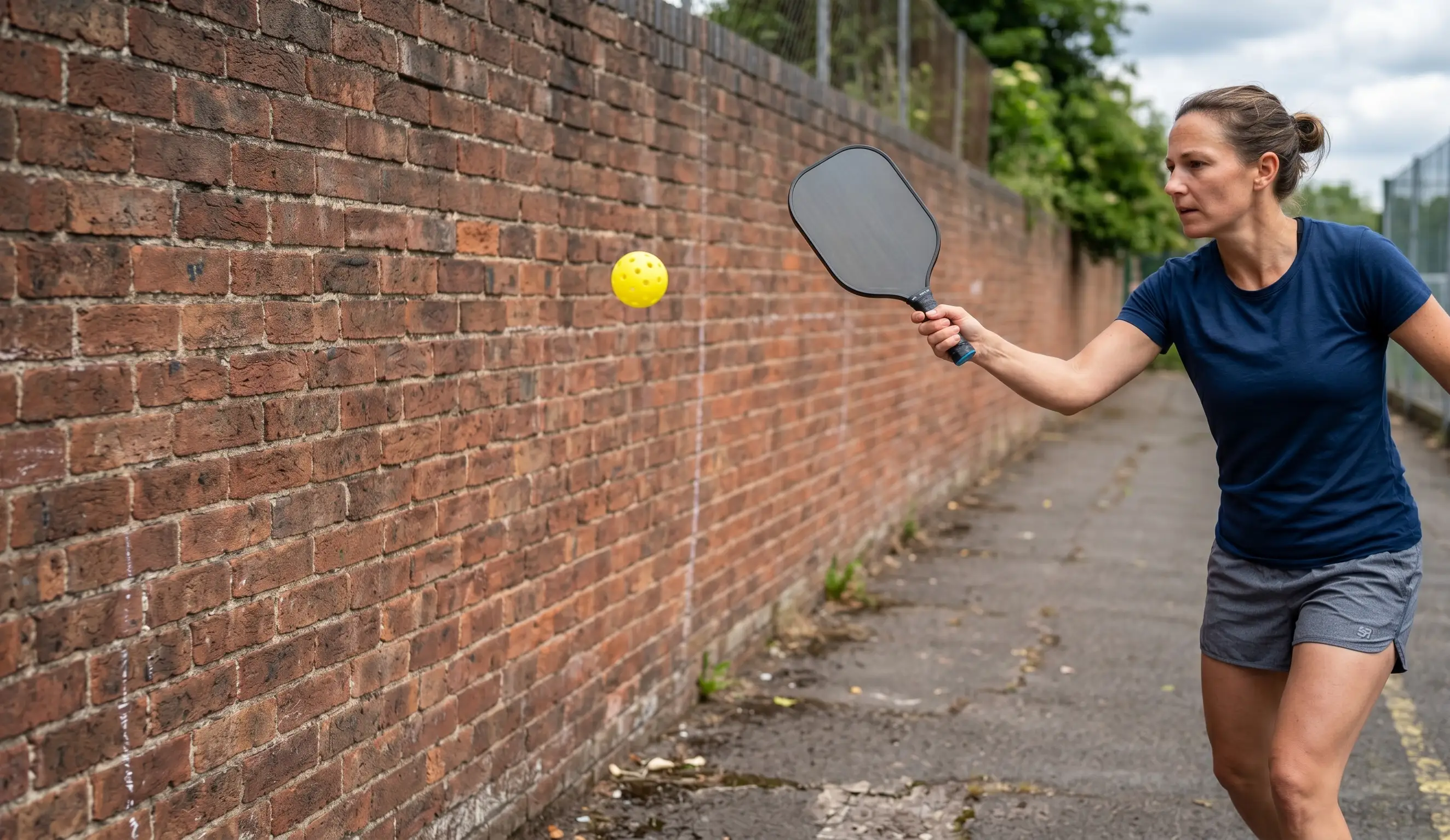
Most people wait for a partner before they practise. That is the single biggest reason improvement stalls.
Open play is great for getting reps in, but it isn't training. You don't control which shots you practise, you can't isolate weaknesses, and the habits costing you points get buried in the noise of a rally. Solo practice is different. Thirty focused minutes alone with a ball and a wall will do more for your game than two hours of casual play.
This isn't a new idea. Tennis players have always trained this way. Squash built an entire training culture around solo wall work. Pickleball is catching up — and if you start now, you'll be ahead of most players at your local club.
Here is what works, and what you need to do it.
What You Need
The basics are minimal:
- Your paddle
- Two or three balls (so you aren't constantly chasing)
- A flat wall with enough space in front of it
- A smooth floor or hard surface to bounce on
No court booking required.
For wall work, look for a solid, flat surface at least 2 metres wide and about the same height as a net — roughly 86cm at the centre. School walls, sports centre exteriors, garage doors, and car park walls all work. The surface doesn't need to be perfect, but rough brickwork makes the ball bounce unpredictably.
If you have access to a court — even one without a net — you can add footwork and serve drills to your session.
The Drills
Wall Rallying — Forehand and Backhand
The wall is your best training partner. It never misses, never gets tired, and always returns the ball.
Stand about 2 to 3 metres from the wall and hit controlled forehands continuously, focusing on clean contact and a low, steady trajectory — above where the net would be. Keep your swing compact. When you are comfortable, switch to backhand only. Then alternate shot by shot.
What you're building: Consistency, contact quality, and rhythm. This is the foundation everything else sits on.
To progress: Move closer to the wall. The ball comes back faster, forcing quicker reactions and tightening your mechanics under pressure.
Dink Wall Work
Move closer to the wall — about 1 to 1.5 metres — and work on soft, controlled dinks. These are the gentle, low shots that land in the kitchen (the non-volley zone near the net) and are central to almost every rally at club level.
Hit the ball softly so it barely bounces off the wall, focusing on touch and repeatability. The goal isn't pace. This is one of the hardest skills to develop in open play because rallies rarely stay soft long enough to get real dink reps.
What you're building: Soft hands, kitchen control, and the patience that club pickleball constantly rewards.
Serve Repetition
If you have access to a court, serve repetition is one of the highest-value solo drills you can do. Stand at the baseline and serve continuously to a target area — a cone, a bag, or a specific spot you're aiming at. Ten serves to the right service box, ten to the left, repeat.
No court? You can still practise your serving motion anywhere with space. Focus on the toss, the contact point, and keeping your swing consistent. Muscle memory is built through repetition, not through rallies.
What you're building: Serve consistency, which removes one of the most common sources of unforced errors in beginner play.
Shadow Footwork
This one needs no ball, no wall, and no court. It is also underrated by almost every beginner.
Walk through your movement patterns in slow motion — the split step as your opponent hits, the shuffle left to cover the forehand, the recovery step back to the centre. Then at half pace. Then at game pace.
Pickleball rallies are lost more often by poor positioning than by poor shot-making. Most beginners are always half a step out of place. Shadow drilling builds the movement habits that fix this without the distraction of also having to hit a ball.
What you're building: Court positioning, recovery movement, and the footwork patterns that let you reach more balls.
Paddle Juggling and Ball Control
Hold your paddle flat and bounce the ball on the face continuously — forehand side, then backhand side, then alternating. Keep it low and controlled rather than high and easy.
This sounds basic. It isn't. Ball control drills directly improve your feel for the paddle face, which transfers to dink accuracy and volley touch during play. Five minutes of this before any session is also an excellent warm-up.
What you're building: Paddle awareness, soft hands, and hand-eye coordination.
How Long and How Often
You don't need long sessions. Twenty to thirty minutes of focused solo drilling is enough — more than that and concentration drops, dragging the quality of your reps down with it.
Once or twice a week alongside your regular club sessions is plenty to see noticeable improvement within a month. The key is consistency over intensity.
Where to Solo Practise in Nottingham
Most of the sports halls Nottingham pickleball runs from — David Ross, Portland Centre, Carlton Forum, Chilwell Olympia — won't let you book wall time separately. But there are options:
- Outdoor courts and tennis club walls: Many have solid side walls suitable for wall drills during off-peak hours.
- Car parks and smooth exterior walls: Plenty of flat surfaces around Nottingham work for dink and rally practice.
- Your own garden or driveway: A garage door or side wall is enough for basic wall work.
- Let's Dink (Caunton): Their outdoor courts offer premium practice options. Book via the Spond app (Group Code: UYPPE).
If you find a good spot locally, share it via our Where to Play page — other Nottingham players will thank you for it.
The Honest Reality
Solo drilling isn't as enjoyable as playing. That's the point. The players who improve fastest at club level are the ones putting in unglamorous reps between sessions — not because they're obsessed, but because twenty minutes against a wall twice a week compounds quickly.
You don't need a partner to get better. You need a ball and somewhere to hit it.
Playing at a Nottingham club and want to find others to practise with? Check our Where to Play page for local venues and clubs running regular sessions.
Stay in the loop.
New courts, sessions and Notts pickleball news — delivered when it matters. No spam.
No group chats. No spam. Unsubscribe anytime.