Paddle Shape and How It Affects Your Pickleball Game
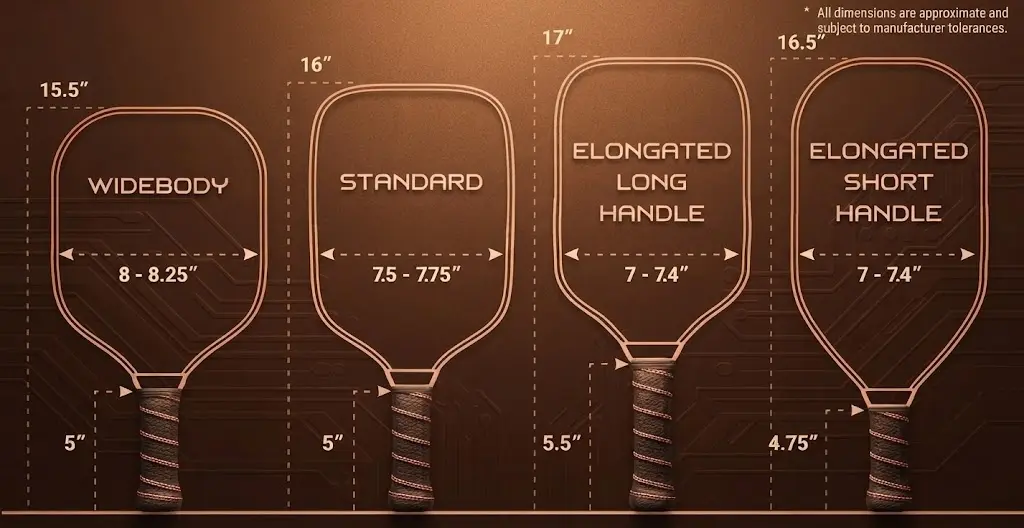
Most players obsess over paddle materials and price. But shape is the one factor that changes how the paddle actually feels in your hand, how much reach you have, and whether your dinks land in the kitchen or sail long.
Here is what each shape does and who it suits.
The Three Main Shapes
Elongated
Elongated paddles are longer and narrower than standard, pushing toward the 17-inch maximum allowed by the IFP rulebook. Within the elongated category there are two distinct variants — and the difference matters.
Elongated long handle — typically 17 inches total length, 5.5 inch handle, face width around 7 to 7.4 inches. The longer handle gives you a two-handed backhand option and more leverage on drives, at the cost of a smaller face.
Elongated short handle — typically 16.5 inches total length, 4.75 inch handle, face width also around 7 to 7.4 inches. The shorter handle shifts more length into the face, giving slightly better reach on the paddle face itself while still maintaining the elongated feel.
What both give you:
- Extra reach — useful at the net and for stretching into wide balls
- More power on drives and serves — the longer lever generates more pace
- A higher swing weight — the paddle feels heavier in motion
Who it suits:
- Former tennis players who are used to a longer swing and want to transfer that power
- Baseline players who rely on pace
- Singles players where reach matters more
- Two-handed backhand players — long handle variant specifically
The trade-off: the sweet spot is smaller and sits higher on the face. Mishits happen more often, especially on fast exchanges at the net. Hand speed feels slower because the paddle is harder to manoeuvre quickly.
Standard (Hybrid)
The most common shape on the market. Typically around 15.5 to 16 inches long with a balanced width. This is the middle ground between reach and manoeuvrability.
What it gives you:
- A larger sweet spot than elongated
- Better balance between power and control
- Easier to handle at the kitchen line
Who it suits:
- All-round players who play both dink-heavy and drive-heavy games
- Players still developing their style
- Anyone stepping up from recreational to competitive play
The trade-off: it does not excel at anything. If you know your game favours power or control, a more specialised shape will serve you better.
Widebody
Shorter and wider than standard. Typically under 15.5 inches with a broader face.
What it gives you:
- The largest sweet spot of any shape — more forgiveness on off-centre hits
- Better hand speed — easier to react quickly at the kitchen line
- More consistent dinking and reset shots
Who it suits:
- Players who live at the kitchen line
- Beginners who want more forgiveness while developing technique
- Doubles players where net exchanges dominate
The trade-off: less reach and less power on drives. If you rely on pace from the baseline, a widebody will feel limiting.
How Shape Interacts With Your Playing Style
Shape does not work in isolation — it interacts with how you naturally play.
If you were a tennis player: you likely have a longer swing, good power, and are comfortable with a narrower sweet spot. Elongated paddles tend to feel natural. The extra reach compensates for the smaller court and the lower net.
If you are a beginner: a widebody gives you more margin for error while your technique develops. Once your dinking and kitchen play is consistent, you can reassess whether to move to a standard shape.
If you play mostly doubles: hand speed at the net matters more than reach from the baseline. A standard or widebody will serve you better than elongated.
If you play mostly singles: reach and power matter more. Elongated paddles give you an advantage on wide balls and on serving pace.
Sweet Spot and Mishits
The sweet spot — the area of the paddle face that returns the most consistent and powerful shots — shrinks as the paddle gets narrower. Elongated paddles have the smallest sweet spot. Widebody paddles have the largest.
This matters most during fast exchanges at the kitchen line where there is no time to adjust positioning. A mishit from an elongated paddle in a fast dink rally costs the point. The same contact with a widebody paddle often stays in play.
Weight Distribution
Shape also affects how weight is distributed through the paddle.
Elongated paddles tend to be head-heavy — more of the mass sits toward the top of the face. This adds power but slows hand speed.
Widebody paddles tend to be more evenly balanced or handle-heavy. This makes them quicker to manoeuvre but reduces the leverage behind drives.
Standard paddles sit between the two.
What Shape Should You Start With?
If you are new to pickleball and unsure, start with a standard shape. It gives you enough reach to cover the court, enough sweet spot to develop consistent technique, and enough manoeuvrability to work at the kitchen line. Once you understand your game — whether you gravitate toward power or control, baseline or kitchen — you can move toward elongated or widebody accordingly.
Shape is personal. The best way to find out what works is to borrow paddles from players at your club and hit with each shape for a session before committing to a purchase. If you are considering your first serious paddle, read our Selkirk Omni review as a starting point for what to look for.
Looking for somewhere to play in Nottinghamshire? Check our courts page for clubs and sessions near you.
Stay in the loop.
New courts, sessions and Notts pickleball news — delivered when it matters. No spam.
No group chats. No spam. Unsubscribe anytime.