How Pickleball Scoring Works: A Complete Beginner's Guide
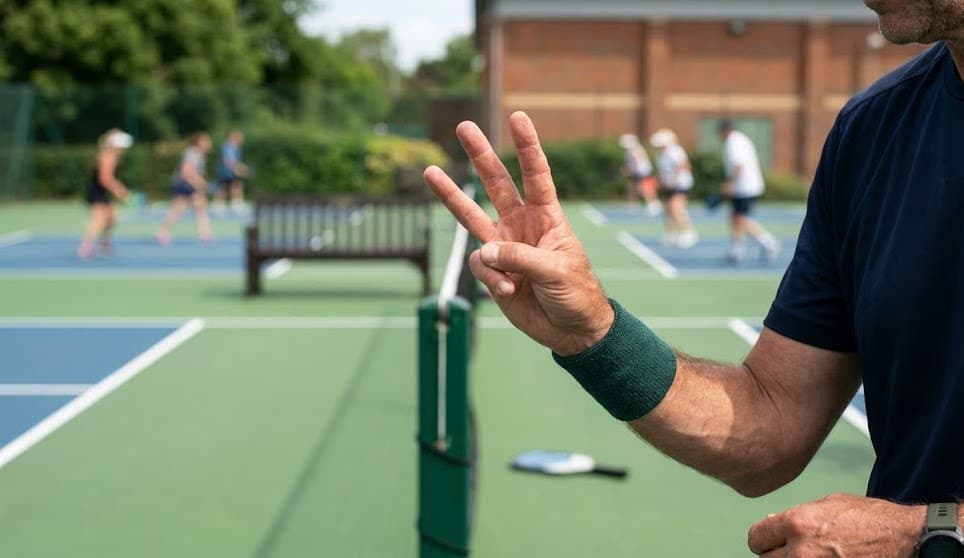
Pickleball scoring is the thing that trips up almost every new player. You watch a match, someone calls "4-2-1" and you have no idea what just happened or why. Then the serve switches, someone calls "2-4-2" and it gets more confusing.
The good news — once it clicks, it's simple. And it will click fast. Most players fully understand scoring within their first session on court. This guide explains it step by step with real examples so you arrive knowing exactly what's happening.
Singles or Doubles — Which Are You Playing?
Scoring works differently depending on whether you're playing singles (1 vs 1) or doubles (2 vs 2).
Doubles is by far the most common format — almost every club session, open play, and beginner session in Nottinghamshire runs doubles. This guide covers doubles first, then explains singles at the end.
Singles is simpler — just two numbers instead of three. If you're playing 1 vs 1, skip straight to the Singles section near the bottom.
The one rule that applies to both: only the serving player or team can score points. If you're receiving and you win the rally — no point. You just win the serve back.
Doubles Scoring
The Basics
Before the three numbers can make sense, you need two foundational rules:
Only the serving team can score points. If you are receiving and you win the rally, you don't score. You simply win the serve back. Winning the serve back is called a side-out.
Games are played to 11, win by 2. First team to 11 wins — but if it reaches 10-10, play continues until one team leads by 2. So 12-10, 13-11, and so on.
That's your foundation. Now the three numbers.
Why Three Numbers?
In doubles — the most common format you'll play across Nottinghamshire clubs — the score is called as three numbers every time someone serves:
Serving team score — Receiving team score — Server number
So "4-2-1" means:
- Serving team has 4 points
- Receiving team has 2 points
- The player currently serving is server number 1
The third number exists because in doubles both players on a team get to serve before the ball passes to the other team. Server 1 goes first, server 2 goes second, then it's a side-out.
Which Player is Server 1 and Server 2?
At the moment your team wins a side-out and takes the serve, whichever player is standing on the right side of the court becomes server 1 for that service turn. Their partner on the left is server 2.
This is important — server 1 isn't a fixed player throughout the game. As players swap sides after scoring points, the person on the right changes. Whoever is on the right when your team wins the serve back is server 1 for that turn.
Server 1 serves until they lose a rally, then server 2 takes over. When server 2 loses a rally, it's a side-out.
A Real Example — Step by Step
Let's walk through the opening of a real game so you can see how it all fits together.
Starting position: Team A is serving. Player A1 is on the right (server 1). Player A2 is on the left (server 2). Team B is receiving. Score starts at 0-0-2.
Why does the game start at 0-0-2? To keep things fair, the first serving team of the game only gets one server instead of two. So the game always starts on server 2 — meaning if Team A loses this first rally, the serve goes straight to Team B without server 1 getting a turn.
Rally 1: Team A serves and wins the rally. Score becomes 1-0-2 — Team A scores, still on server 2.
Rally 2: Team A serves again and loses the rally. No point scored. Team A was on server 2, so it's immediately a side-out. Serve passes to Team B.
Score when Team B takes the serve: 0-1-1
- Team B (now serving) has 0 points
- Team A has 1 point
- Team B is on server 1
Rally 3: Team B serves and wins the rally. Score becomes 1-1-1 — Team B scores, still on server 1.
Rally 4: Team B serves and loses the rally. Server 1 lost — server 2 takes over. No point scored, no side-out yet. Score becomes 1-1-2 — same score, now server 2 serving.
Rally 5: Team B serves and wins the rally. Score becomes 2-1-2 — Team B scores again.
Rally 6: Team B serves and loses the rally. Server 2 lost — side-out. Serve passes back to Team A. Score when Team A takes the serve: 1-2-1
- Team A (now serving) has 1 point
- Team B has 2 points
- Team A is on server 1
The Positions Switch When You Score
When your serving team wins a point, you and your partner swap sides of the court. The player who just scored moves from right to left, their partner moves from left to right. The server then serves from the other side.
The receiving team never swaps when a point is scored against them — they stay put.
The helpful tracking trick: Check your team's current score. If it's an even number (0, 2, 4, 6...) the player who started the game on the right should be back on the right. If it's an odd number (1, 3, 5, 7...) that player should be on the left. If someone is standing in the wrong place, this check will catch it.
Calling the Score
Before every serve, the server must call the score out loud — three numbers, always in the same order. Your score, their score, server number.
If your team has 6 points, the other team has 4 points, and you're server 2 — call "6-4-2" before serving.
In recreational play across Nottinghamshire clubs, nobody will penalise you for forgetting. If you lose track, just ask — everyone has been there.
Singles Scoring — Much Simpler
Singles is just two numbers — your score, then your opponent's score. No server number needed.
Serving position in singles:
- Even score = serve from the right side
- Odd score = serve from the left side
That's it. Significantly easier to follow than doubles.
What About Rally Scoring?
At professional tournaments you might see rally scoring — where every rally scores a point regardless of who served. This makes TV matches faster.
Rally scoring is not used in recreational play. Every club session you attend across Nottinghamshire uses traditional side-out scoring as described above.
The One Thing to Remember
If this feels like a lot — focus on these three things for your first session:
- Only the server scores
- Call three numbers before you serve
- Swap sides with your partner when your team scores
Everything else clicks within your first game. Scoring is much easier to understand with a paddle in your hand than on a screen.
Ready to find a session? Our Where to Play page lists venues and clubs running regular pickleball across Nottinghamshire.
New to pickleball entirely? Start with our Beginners Guide before your first session.
Stay in the loop.
New courts, sessions and Notts pickleball news — delivered when it matters. No spam.
No group chats. No spam. Unsubscribe anytime.